Bleaching
Gentle tooth whitening for a radiant white smile.
Learn more
If loose, brittle teeth or poorly fitting dentures are making your daily life difficult, there’s one thing you want more than anything else: to be able to eat, speak, and laugh without discomfort again. With the All-on-4 method in Zurich, we can provide you with fixed teeth in just one day—four precisely placed implants form the stable foundation for your new, complete set of teeth.
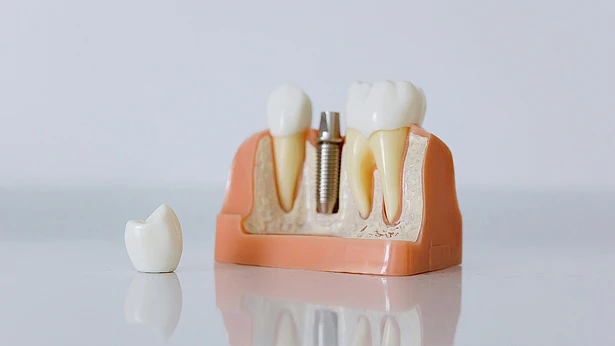
At the Zahnkronenhalle Zurich in Bellevue, Dr. stom. Gonzalo Olivares Carbonell, a specialist in oral surgery, and his practice team will tailor your All-on-4 treatment entirely to your individual needs. Using precise 3D X-rays and digital implant planning, we tailor the implants and your new dentures exactly to your jaw.
All-on-4 is designed for people who want to replace an entire arch of teeth in the upper or lower jaw. Having an existing denture is not a requirement.
The All-on-4 treatment is suitable for patients with:
Healthy teeth that are worth preserving are included in the treatment plan. All-on-4 provides a fixed restoration for a full dental arch. Schedule your personal initial consultation at the Zahnkronenhalle in Zurich. There, we’ll discuss your dental situation, your preferences, and the appropriate next steps with you.
If you’re scheduled for All-on-4 treatment at Zahnkronenhalle Zurich, we’ll attach your fixed temporary bridge on the day of implantation. This means you’ll have fixed replacement teeth right away and won’t have to live with a removable temporary prosthesis for an extended period of time.
The permanent All-on-4 bridge is placed after the healing phase.
The All-on-4 bridge is permanently attached to the implants. You don’t have to put the teeth in, take them out, or secure them with adhesive cream every day.
This makes everyday life easier and gives you more confidence when eating, speaking, and laughing.
A full denture rests directly on the gums and can therefore cause pressure points. The fixed All-on-4 bridge is supported by the implants.
This can improve comfort while chewing. The bridge is designed to fit well and be easy to clean.
A traditional upper-jaw denture often covers the palate. The fixed All-on-4 bridge can be designed to be palate-free in the upper jaw.
This gives you more space in your mouth. Many patients find this more comfortable when speaking, eating, and wearing the prosthesis on a daily basis.
When a denture shifts out of place, some people avoid certain foods, conversations, or situations. A fixed All-on-4 bridge remains securely attached to the implants throughout daily life.
You can once again speak, laugh, and enjoy meals with others without any worries.
All-on-4 treats the entire dental arch as a single unit. Implants, the temporary bridge, and the permanent bridge are planned together.
This is particularly beneficial when multiple teeth are missing or severely damaged. You’ll receive a clearly structured plan from the initial consultation through to your permanent dental restoration.
All-on-4 is designed to restore an entire dental arch in the upper or lower jaw. The concept is therefore particularly suitable for patients with an edentulous jaw, severely loose teeth, or a full denture that no longer provides satisfactory results.
The posterior All-on-4 implants are placed at an angle. This allows for the targeted use of the available bone. In many treatment situations, this reduces the need for extensive bone grafting. Planning is carried out using digital volume tomography (DVT), a three-dimensional X-ray image of the jaw.
Your Needs Are Our Priority
. During the initial All-on-4 consultation, we’ll discuss your current dental situation and your goals. Do you suffer from loose full dentures, painful teeth, or difficulty chewing? Would you like fixed dentures that stay securely in place during everyday activities? You’ll receive clear information about the next steps.
We’ll discuss with you:
This provides you with a clear foundation for making your decision. Your concerns and fears are taken seriously.
Safety Through Clear Planning
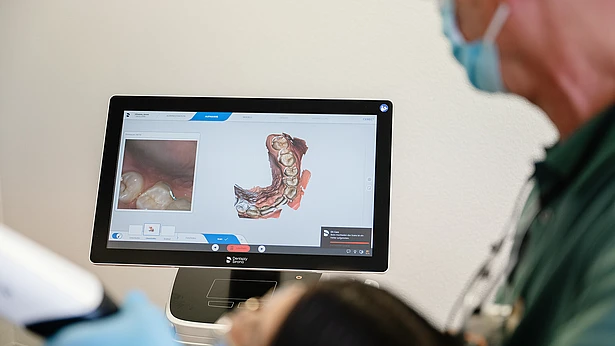
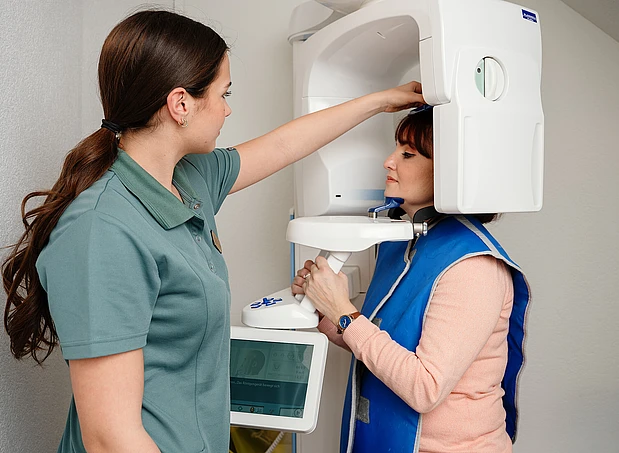
To plan your All-on-4 implants, we take a DVT scan. DVT stands for digital volume tomography. This is a three-dimensional X-ray image of the jaw. It shows the jawbone and important anatomical structures from various angles.
Based on this, we plan:
Digital implant planning integrates the surgical procedure with the subsequent dental restoration. This ensures that the implants, bridge, and dental laboratory work are coordinated from the very beginning. This provides you with a clear treatment plan and minimizes any unanswered questions before the procedure.
For the fabrication of the temporary and permanent bridges, Zahnkronenhalle collaborates with a dental laboratory partner in Switzerland.
Clear Information Before the Procedure
Before the All-on-4 treatment, we will discuss the planned procedure, the anesthesia, and the individual services with you. You will receive a personalized cost estimate. It will outline the treatment steps and dental laboratory services that are planned.
Depending on the type of restoration, the treatment plan includes:
You will receive this information before the procedure. This will allow you to plan your treatment at your leisure and get your questions answered well in advance.
Fixed Teeth Immediately After the Procedure
On the day of treatment, we place the four All-on-4 implants. The procedure is performed under general anesthesia or a customized anesthetic plan. We will discuss the type of anesthesia with you in advance.
After the procedure, we attach your fixed temporary bridge to the implants. This bridge replaces your entire dental arch during the healing phase. This means you’ll leave the dental clinic with fixed teeth and won’t have to live with a removable temporary solution for an extended period.
After the All-on-4 treatment, you will receive personalized instructions regarding:
After general anesthesia, you are not allowed to drive yourself. You will need someone to accompany you.
Implants fuse with the jawbone
. During the healing phase, the implants fuse with the jawbone. This biological process is called osseointegration. The temporary bridge remains in your mouth during this time, allowing you to have stable teeth for your daily activities.
During follow-up visits, we’ll monitor the healing process and answer any questions you may have. You’ll also receive ongoing guidance on how to clean and care for your All-on-4 restoration. You should avoid hard or very chewy foods initially, following the instructions provided by the treatment team.
Your Long-Term Fixed Dental Restoration
After the healing phase, the temporary bridge is replaced with the permanent All-on-4 bridge. The permanent bridge is your long-term fixed dental restoration. It is customized to your specific needs in terms of shape, color, bite, and comfort.
The partner laboratory fabricates the permanent bridge based on the digital planning and specifications provided by the practice. Before placement, we check the fit and function. The result is a restoration that blends harmoniously with your face and bite.
The cost of All-on-4 treatment at Zahnkronenhalle Zurich depends on the diagnosis and the scope of the treatment. Factors that play a role include the jaw being treated, the condition of the existing teeth, any necessary tooth extractions, preliminary treatments, anesthesia, the temporary and permanent teeth, and the dental laboratory work.
Before treatment begins, you will receive a personalized cost estimate. The planned procedures and costs will be clearly explained to you.
Schedule an initial consultation to receive a transparent cost estimate.
Planning
Surgical Treatment with Experience Dr. stom. Gonzalo Olivares Carbonell is a dental specialist in oral surgery. This means he specializes in surgical procedures in the mouth, on the jawbones, and on the surrounding tissues.
As part of your All-on-4 treatment, he will plan, among other things:
For you, this means: The surgical steps are planned by a specialized dentist and explained in a way that’s easy to understand. You know who is performing your treatment and who to contact with any questions.
Accurate Imaging
of the Jaw Before All-on-4 treatment, your jaw is imaged in three dimensions using digital volume tomography (DVT). A DVT is a special type of 3D X-ray. It shows the jawbone and important anatomical structures from various angles.
The DVT scan forms the basis for the digital planning of your All-on-4 implants. During this process, we plan:
This plan helps you better understand the treatment process. It also shows how the implants and the fixed dental prosthesis fit together.
Temporary and Permanent Bridges Based on a Single Treatment Plan
The All-on-4 implants and the fixed bridge must be precisely matched. That is why Zahnkronenhalle Zürich collaborates with a partner dental laboratory.
The Swiss partner laboratory manufactures the temporary and permanent All-on-4 bridges according to the specifications of the joint treatment plan. In doing so, important details are taken into account:
For you, this means: Your temporary restoration and your permanent bridge are not planned independently of one another. The dental laboratory work is tailored to your treatment plan and your personal preferences.
Clear Answers Instead of General Information
: All-on-4 treatment raises many questions. You want to know how the procedure works, how long the healing process takes, what type of anesthesia is used, and what the costs are.
During your in-person All-on-4 initial consultation, we’ll discuss the following with you:
You’ll receive clear answers and can discuss your questions directly with the treatment team. This provides guidance before you decide on the next steps.
Zahnkronenhalle Zurich near Bellevue
Zahnkronenhalle is located at Rämistrasse 2 near Bellevue in Zurich. You can walk to the practice from Stadelhofen Station. From the main train station, take the tram.
The central location is convenient for your initial consultation, treatment, and follow-up appointments. This ensures that your care remains easily accessible even after your fixed bridge is placed.
Swelling, tenderness, and pain at the site of the wound may occur in some cases after the procedure. You will receive instructions regarding diet, oral hygiene, and taking medication. During the first few days, soft foods that aren’t too hot are usually best. Hard or very chewy foods can interfere with healing and put strain on the temporary bridge.
If you experience severe or worsening pain, a fever, persistent bleeding, or noticeable swelling, please contact the dental office.
Clean your All-on-4 bridge daily. Pay special attention to the area under the bridge and to the implants. Plaque and food particles can accumulate there. Depending on your restoration, you may use a soft-bristled toothbrush, special floss for implant bridges, or interdental brushes. The treatment team at Zahnkronenhalle Zurich will show you the proper technique.
Checkups and professional dental hygiene complement your at-home care. Professional teeth cleaning prevents inflammation and ensures that your All-on-4 teeth remain stable for many years.
Zirconia is a tooth-colored ceramic material used for fixed dental restorations. It is suitable for a permanent All-on-4 bridge with a natural tooth color and a clean, modern aesthetic.
Zirconia offers the following properties:
The permanent zirconia bridge is digitally designed and fabricated in a dental laboratory. The shape of your teeth is tailored to your face, your smile line, and your bite.
In a titanium-resin composite, a precisely manufactured titanium framework forms the stable base of the All-on-4 bridge. Tooth-colored resin teeth are then attached to it.
This option is often chosen when a lightweight and adaptable restoration is desired. Key features include:
The resin teeth may show signs of wear over the years. If necessary, the restoration can be examined and adjusted at a dental laboratory.
In a metal-ceramic bridge, a metal framework serves as the supporting structure. The visible areas are veneered with tooth-colored ceramic. This results in a stable and aesthetically pleasing restoration for a full dental arch.
Metal-ceramic has been used for fixed dental restorations for many years. Its most important properties are:
The final All-on-4 bridge is designed to match your bite, your smile, and your desired dental aesthetics.
Whether you’ve been wearing full dentures, still have your own severely damaged teeth, or are living without fixed dentures: The permanent All-on-4 teeth give you a new, fixed set of teeth. This may initially change the sensation in your mouth, your bite, and your speech.
Many patients are especially looking forward to having fixed dentures again. The adjustment process happens step by step. You’ll get used to the new shape of your teeth, the firm feeling when chewing, and the change in how your tongue moves.
During the follow-up checkup after placement, we’ll pay close attention to:
Take some time during the first few days to get used to your new fixed teeth. If your bite feels unbalanced, your speech remains permanently altered, or a pressure point develops, we’ll check your All-on-4 bridge and make adjustments as needed.

Yes, with All-on-4 treatment at Zahnkronenhalle Zurich, we attach your fixed temporary bridge on the day of implantation. This means you’ll leave the dental office with fixed temporary teeth rather than a traditional removable temporary solution.
The temporary bridge remains in your mouth during the healing phase. Afterward, it is replaced by the permanent All-on-4 bridge. We’ll discuss how to care for your temporary teeth and what to eat during the initial recovery period with you after the procedure.
The cost of the All-on-4 procedure is calculated based on your planned treatment and listed in a personalized cost estimate. This allows you to see which services are planned for your specific case.
Possible components include:
The cost depends on the jaw being treated, the necessary treatment steps, and the material used for the permanent bridge. You will receive a detailed cost estimate before treatment begins.
No, the All-on-4 teeth are permanently attached to the implants in everyday life. You do not insert or remove the bridge yourself. The dentist can remove the bridge for checkups, repairs, or professional cleaning. Daily care of the fixed bridge is still important, however.
While traditional implant treatments often require six to eight implants per jaw, the All-on-4 method requires only four—two in the front and two in the back of the jaw. As a result, the procedure is shorter, less invasive, and usually does not require bone grafting. At the same time, the immediate restoration provides you with fixed teeth right away—a major benefit for both function and self-confidence.
The All-on-4 procedure is performed under anesthesia tailored to your individual needs, so you should not feel any pain during the treatment. After implantation, you may experience swelling, tenderness, and soreness at the incision site.
Anesthesia and post-operative care include:
The exact duration of the procedure will be determined prior to treatment based on your treatment plan. On the day of treatment, the All-on-4 implants will be placed and the fixed temporary bridge will be secured.
Depending on the treatment plan, the process includes:
This way, you’ll know the individual steps and can better plan your treatment day.
We take into account your own healthy teeth that are worth preserving when planning treatment.
Not every existing tooth needs to be removed. In cases of severely damaged teeth or those that are not worth preserving, we will discuss the next steps in your treatment with you.
In doing so, we consider, among other things:
This results in a treatment plan tailored to your entire dental arch.
Before your All-on-4 treatment, you will receive personalized instructions regarding medications, food, drink, and who should accompany you. Please inform the treatment team of any medications you are taking. This includes blood thinners, diabetes medications, and over-the-counter medications.
Before the procedure, we will discuss the following with you:
This way, you’ll know before the day of treatment how to prepare and what you need to arrange.
In the first few days after the All-on-4 procedure, you should reduce physical activity and plan for a period of rest. How soon you can return to work or resume exercise depends, among other things, on the nature of your work, the extent of the procedure, and your personal healing process.
For the time being, please:
If you have a sedentary job, your return to normal activities may differ from that of someone with a physically demanding job. You will receive personalized instructions after the procedure.
If an All-on-4 implant does not heal properly, the treatment team at Zahnkronenhalle Zürich will assess the situation and adjust the treatment plan accordingly. Depending on the findings, a treatment break, an adjustment to the temporary bridge, or a replacement implant may be necessary. The next steps depend on the healing process and the stability of the remaining implants.
In this case, it is important to:
In Switzerland, mandatory basic health insurance generally does not cover All-on-4 treatment for routine tooth loss. Different rules apply in cases of certain serious illnesses or special medical conditions. Depending on the policy, supplemental insurance may help cover the costs of dental prostheses or implants. Following an accident, accident insurance may be responsible for the costs.
Before treatment, check:
You should check the exact insurance terms and conditions directly with your insurance provider.
Yes, tooth shape, tooth color, and tooth alignment are taken into account when planning your permanent All-on-4 bridge. The design of your fixed dentures is based, among other things, on:
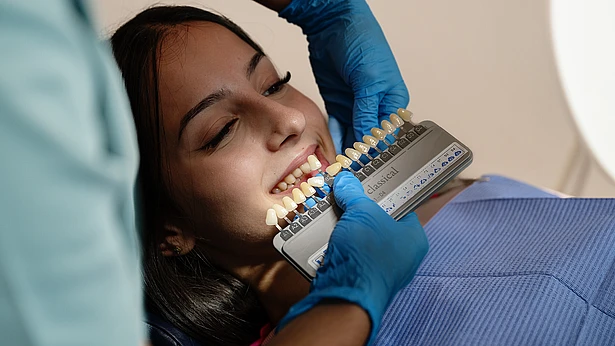
Zahnkronenhalle Zürich coordinates the temporary and permanent bridges with its partner dental laboratory. During the consultation, you’ll discuss the aesthetic look you’d like your new teeth to have.